To write survey questions with AI, start with the decision you need to make, define who can answer, and request both the wording and the route through the form. Then review each answer option and test every branch before inviting respondents. A fluent question can still push people toward praise or ask them about something they never tried.
This guide uses a fictional folder-organizing app and an original, worked questionnaire. The examples are editorial illustrations, not results from a live AI test or a survey of real customers.
1. Define the decision before asking for questions
Imagine a team considering improvements to the app’s folder-renaming flow. It wants to understand recent attempts: whether people completed the rename, how completed attempts felt, and what made an attempt difficult. It is not trying to measure overall satisfaction with the entire app.
- Audience: people who use the fictional app.
- Recall window: the past seven days.
- Unit of experience: the respondent’s most recent folder-renaming attempt during that window.
- Output: four numbered questions, answer choices, and explicit routing.
- Limit: a short, voluntary questionnaire with no names, account IDs, or uploaded files.
This brief gives the draft a boundary. A question about pricing might be interesting, but it would not help this particular review. People who did not attempt a rename should not be asked to rate that experience.
2. Ask AI for wording, options, and routing together
Draft a short survey for a fictional folder-organizing app.

Goal: understand the respondent’s most recent folder-renaming attempt in the past seven days.

Use four numbered questions:
Q1: whether they attempted a rename in that window.
Q2: whether that attempt was completed.
Q3: ease of the attempt, only for people who completed it.
Q4: optional text about anything that made the attempt difficult.

Use plain wording without praise or assumptions of success. Give single-choice options for Q1–Q3, including uncertainty where appropriate. Specify the next question for every option. People who did not try, or cannot recall trying, should finish after Q1. Everyone reaching Q2 should reach Q4, directly or through Q3.

Do not invent responses, completion times, or claims that this survey is validated. After the draft, identify wording and routing decisions a human needs to review.
If you already have a form, include its exact questions and routes. Ask for a change log so you can see whether the model merely corrected wording or changed what the survey measures. Avoid adding customer records when the task only requires drafting the questionnaire.
3. Repair the question before polishing its tone
Consider this intentionally poor draft: How much did you love our fast and easy folder renaming? It assumes a positive reaction, describes the feature as fast, and combines speed with ease. Someone could find it easy but slow. A single answer would leave that distinction unresolved.
For this brief, replace it with How easy or difficult was it to rename the folder on that attempt? Ask it only after the respondent reports completing the rename. If speed becomes a separate research goal, add a separate question deliberately instead of quietly folding it into the ease rating.
Pew Research Center’s guidance on writing survey questions explains why clear wording, one concept per question, non-overlapping response options, and pretesting matter. These principles guide review; asking AI to apply them does not establish that a questionnaire is unbiased or validated.
4. Review a complete questionnaire
Example introduction: We are reviewing folder renaming in this app. Please think about the past seven days. Taking part is optional. Please do not include names, account details, or private folder contents in your written response.
Q1. In the past seven days, did you try to rename a folder in this app?
- Yes → Q2.
- No → finish.
- Not sure → finish.
Q2. On your most recent attempt in the past seven days, did you finish renaming the folder to the name you wanted?
- Yes → Q3.
- No → Q4.
- Not sure → Q4.
Q3. How easy or difficult was it to rename the folder on that attempt?
- Very difficult.
- Somewhat difficult.
- Neither easy nor difficult.
- Somewhat easy.
- Very easy.
- Not sure.
Choose one answer. Every Q3 answer leads to Q4. Keep the five ease ratings in their meaningful order; keep “Not sure” separate from the midpoint when analyzing answers.
Q4. What, if anything, made this rename attempt difficult?
Optional written answer. Respondents may leave this blank. After Q4, show a thank-you message and finish the questionnaire.
This version intentionally measures ease only among respondents reporting completion. It cannot describe ease among everyone who attempted a rename. If you need both groups’ experience, redesign that question and its route before collecting responses.
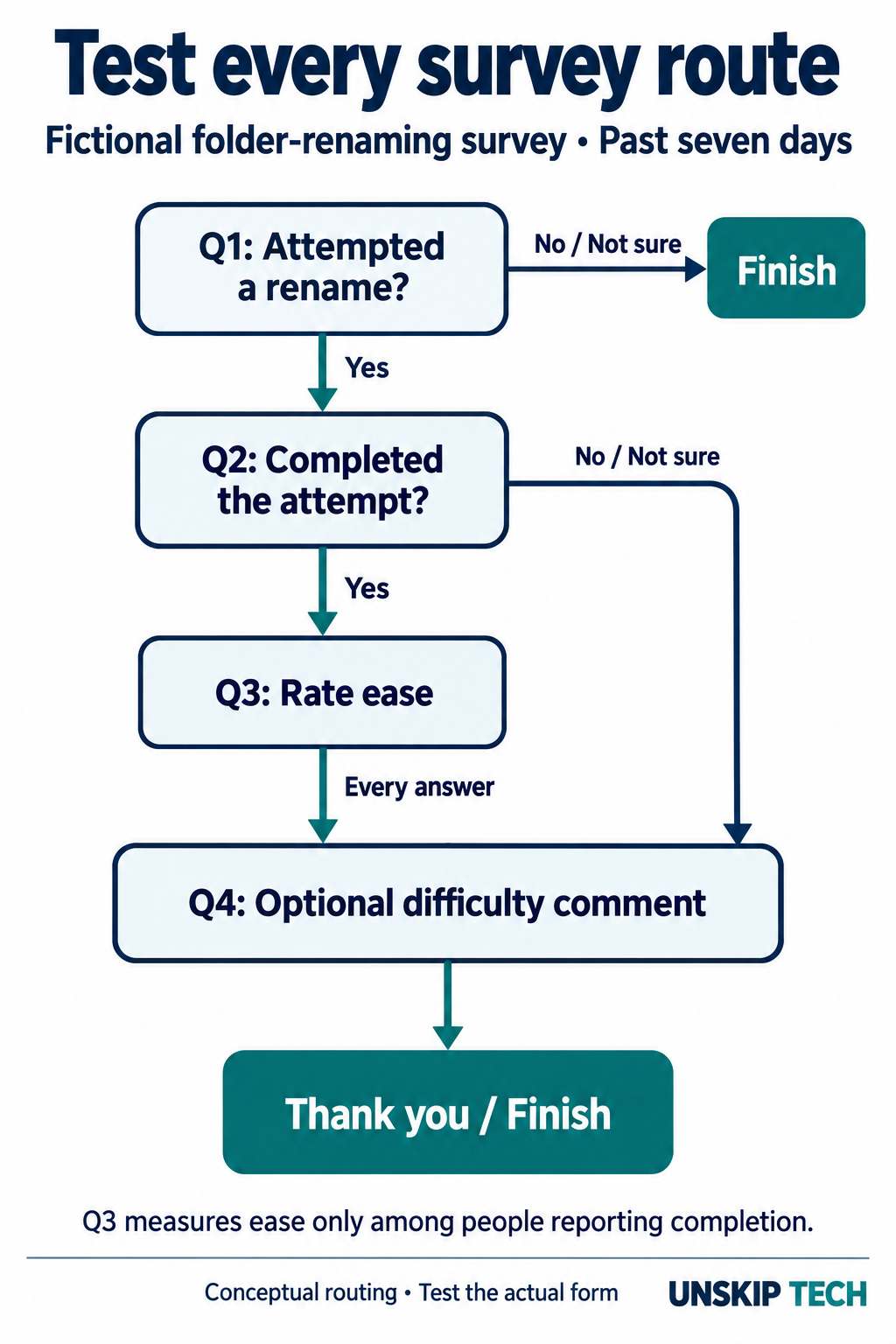
5. Walk through the branches before sharing
Do not accept a model’s “all paths checked” statement by itself. Open the actual form preview and follow each route. The following are fictional test cases, not survey findings.
| Test answer pattern | Expected route | Check |
|---|---|---|
| No attempt | Q1 → finish | No experience rating |
| Unsure about attempt | Q1 → finish | No forced recall |
| Attempt completed | Q1 → Q2 → Q3 → Q4 | Ease rating appears |
| Attempt not completed | Q1 → Q2 → Q4 | Skips ease rating |
| Completion uncertain | Q1 → Q2 → Q4 | Can describe difficulty |
Also try leaving Q4 empty, using “Not sure” at Q3, and changing Q1 after going back from a later page. Check that the submitted record does not retain hidden answers from a route that no longer applies. Form behavior depends on how you build it; the text above does not configure a survey tool for you.
Then ask a few people from the intended audience to explain the questions in their own words. Watch for confusion about “folder,” the seven-day window, and which attempt they should remember. Revise the draft and repeat the affected paths. This checks understanding and operation, not statistical representativeness.
6. Preserve the question context when reviewing responses
Save the wording, answer choices, routes, and version date with the responses. In this example, Q3’s denominator is the people who answered Q3, and any ease summary should explain how uncertain or missing answers were handled. Do not convert “Not sure” into a neutral rating.
Recruitment also limits conclusions: volunteers responding to an invitation are not automatically representative of every user. AI-generated sample answers can help exercise a form, but they are not customer evidence and should stay out of the real response dataset.
After collecting genuine written answers, use the separate guide to organizing customer feedback with AI to label comments and keep counts traceable. Start with the reviewed questionnaire here; analyze only what respondents actually supplied.